- The Open Absence
- Posts
- Sow Your Wild Poets 2/15/2026
Sow Your Wild Poets 2/15/2026
Little Reviews of Poetry Collections from 2017 Cuba & 2014 Turkmenistan

Justin Goodman
February 15, 2026
(Thumbnail by Alexei Sergeenko on Unsplash)
Laura Ruiz Montes’ Transparencies
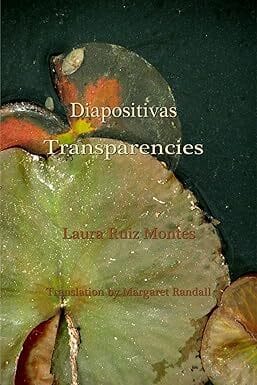
The 1970 mass mobilization of sickle-wielding Cubans to the sugar cane fields, called the zafra de los 10 milliones, is an apt symbol of the world of Laura Ruiz Montes’ poetry. She herself was born in 1966 and was surely surrounded by tales of camaraderie, the satisfaction of hard work for a felt cause, and love of embodying a free nation, but, equally, as Ada Ferrer puts it in her Cuba: An American History, “the harvest amounted to 8.5 million tons of sugar, the largest harvest in Cuban history. But it came at a time when the world price for sugar was less than half of what it had been earlier in the decade.” The enormity and fragility of achievement, empowerment and defeat as two cheeks of the same face, bleed through her 2017 collection Transparencies. Blood not just drifting from the body’s arteries, but from time’s, where the thrifty restoration of objects invokes fathers and grandfathers nicking their cheeks when shaving “and turned the other, and the next afternoon/emerged again, optimistic, wounded and bleeding.” This movement from era of plenty to era of lack that is the nostalgic repetition of those “sick things from a previous era,” this “Restoration,” as this poem is titled, is time itself drifting into Montes’ poems, leaving their pages transparent.
Specifically, repetition is how Montes relates to the “sick things” when in “Place Names” “you enter and leave the stores” twice, feel “for a while now, finding Obispo/or Calos III has nothing to do/with religion or history” twice, place names returning to the image of a TV that you either “channel-surf./flitting from one to another” or which are “like the blue screen/whose silence at dawn/tells you there’s nothing more to see” — where “everything ends or begins again,” with a freighted “or.” Margaret Randall’s translation captures the heaviness of the wheel struggling in the ditch of Montes’ original Spanish. It’s the plainness of Montes’ style that cruelly emphasizes the “ends or begins” of embargoed Cuban life; “Hypothesis,” a spiraling theorizing about social meanness in the image of lost connection to a loved one, “something that kept her from hearing the phrase,” before ending indecisively with an ellipses like a lost connection, has parallels to the Bulgarian poet Kristin Dimitrova whose “Noah, The Carrier,” has a similar spiraling shape. In Dimitrova's poem, however, after recasting the flood myth to each audience’s expectations, he murmurs “”truth does not/make a good myth/yet only myth can carry it.” In Transparencies we discover what it looks like to live in the uncarried myth, poverty prices after a legendary harvest, time returned to the mythological.
Miami in the 60s and early 70s, Ferrer writes, was a “kind of alternate universe….a place steeped in counterrevolution rather than counterculture.” It’s to this reactionary zeal against Cuba, whose names have as much to do with its lived religion or history as the US’ place names, that Montes writes. From inside the myth of the Cuban Revolution she writes “call me what you will”:
Freedom…
although only I know
you are talking about the statue
in that little provincial park
and it has nothing to do with ideology,
but with those moments
when seated there
we avoided the bird droppings
that fell from the sky
From outside the myth there is only ideology and stone, without all the other (literal) crap that a daily life entails. The repetition of permission to name the poet is the acceptance of place as that which “you enter and leave,” where even name is a placeholder for a lived life. The one demand, the final demand, of the collection being to not:
try to call me Nation. Do not.
Do not give me that responsibility,
that illustrious job,
the glorious duty,
the burden.
And it’s in the final word, “burden,” that the sharpness of Montes’ ambiguity is felt. In Spanish Montes writes “el gravamen.” This not only means a general sort of burden — and worth noting here that the most famous burden, Kipling’s “White Man’s Burden,” was a response to the same global reality that saw Cuba functionally colonized by the US — but also to financial burdens imposed by a higher authority, such as a tax, lien, or levy; in English, gravamen is still used in the law to describe the central complaint of a lawsuit. “Gravamen” is the truth that myth has to carry, the central complaint, the embargo. It’s precisely the truth which, as the US murderously impoverishes Cuba, reproduces those myths that ignore that those calling each other what they will are beings swept up in time, spied on by the curious and zealous: “Only I know/you are talking about the statue…and it has nothing to do with ideology.”
Favorite Poems:
“Domestic”
“Restoration”
“Hypothesis”
“Place Names”
“Bulletproof”
“Prepared for Defense”
“Routes”
“Bartering”
“Call Me What You Will”
Magtymguly’s Poems From Turkmenistan
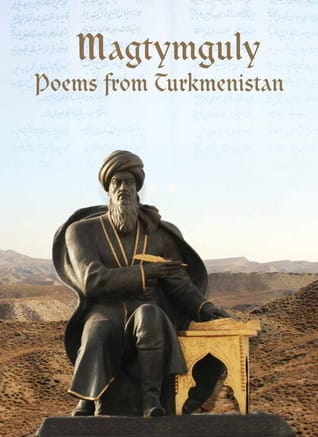
Stranger than the historical distance between a 21st century American reader and the 18th century father of Turkmen poetry, Magtymguly: Poems from Turkmenistan is a strange product. An extension of the national revival policy of first Turkmen president Saparmurat Niyazov (15 years in charge) following the collapse of the Soviet Union, and introduced by then Turkmenistan president Gurbanguly Berdinuhmedow 8 years before he would pass the presidency to his son in 2022, it has the awkward, but loud, silence of a rump parliament — it’s not an accident his praise includes how Magtymguly “put forward an initiative of consolidating around one personality.” But really it’s not just that the overeager size of the collection (174 poems) belies its lack of literary discrimination, or that some phrasing is so egregious that it reads like direct translation, or that the endnotes are half a page long and feature such helpful clarifications as “The Prophet Mohammad,” or that we lack contextualization about Turkmen poetry or Magtymguly’s place in that space. The loud, awkward silence of the collection is a cold air squeezing heat out of the atmosphere of a poet who, by all accounts, is as strikingly fiery as he is surreally holy.
Take for example the poem titled “What Should I Do, Now I Am Wretched?” The director of the Asian Cultural History program at the Smithsonian, who published the book, explains the names are products of “a 1926 edition of Magtymguly’s poems compiled by Berdy Kerbabayev.” An understandable name, if a shame that such a clunky title is followed by dirge to one’s lot that has lines as striking as “I was sweet basil in the Garden of Eden” and “and now I am a palace in ruins.” A shame continued by the latter being preceded by the mundane phrase “I was safe and sound.” The paradise lost returns in one form or other throughout, but the most memorably (derogatory) “I Am Separated”: “the orchard of the eight layers of the Paradise/I am separated from this orchard.” The stuttering “of the” distracts from the extremely literal translation of what’s most certainly Jannah; while Paradise has a sweeter sound than the more common “Heaven,” retaining the direct pronoun is absurd to the ear. Even worse that following this is the scholastic-sounding “this orchard,” as if the reader were bogged down by in a thesis paper needing to be reminded of the referent from the previous line. No liberties were taken with the translations, no art involved, and it’s renders the mourning abundant in the collection a little ludicrous.
It's for those sprigs of sweet basil that you scour through the poems for, however. In “It is Stubborn, My Friends” Magtymguly writes “a soul is a blindfolded bird, my friends.” In “The Hasar Mountains” he says “a mountain is the sultan of the earth.” In “Parting” he bemoans that he is “a flood not wanted by anyone,” “honey mixed with poison,” and, most strangely, “wretched flower that separated from its nightingale.” In “Until He Knows What It Means” he asks:
How many evils will be seen?
How many good or bad words will be spoken?
The hunters will keep going to the mountains,
Until they become very old.
These images all bind earthly life to its most inhabited, peculiar because transient. Magtymguly was not just from a nomadic culture, but himself carries transience as a kernel within himself. The flood, a force of both silt and rubble, is missed; the mountain, a timeless presence, is an earthly almighty; the soul, in search of a flower no less wretched, flies blind — quietly (Magtymguly at his most quiet) men continue to hunt in the mountains, among the questions.
Perhaps nothing better summarizes the mixture of genuine poetry and oafish national project than the final poem “Dedicate, Pyragy.” As Adrienne Lynn Edgar highlights in her Tribal Nation, “The people who identified themselves as Turkmen had not one story to tell about themselves, but many—stories that often conflicted and competed with each other.” Yet “Dedicate, Pyragy” is, like all Magtymguly’s work, the ambition for future transience; so that the stories of the peoples who reside in Turkmenistan may become one story to dedicate a poem to, a poem to the future. And in that dedication, a dedication to a symbolical and personal love whose “face like a full moon reminds me of the Paradise,/Black curls of her hair are “Welleyli”; her eyebrows are like a crescent in the dark sky.” Despite another “the Paradise” and the never defined “Welleyli,” the grief with the joy, the present with the promise, mix into the weight of each stanzas repeated final line: “dedicate [the blessings of skillful brave men] to your nation before you pass away, Pyragy.” Despite the authoritarian’s nationalist tilt and the desperate translation struggling to overcome its limitations, there is a genuine love here, genuine beauty, as if you can hear it said:
Having taken the world’s beauty in your hands
Do grant it to your people, before you pass away.
Don't conceal all things, whether good or bad.
Dedicate them to your nation, Pyragy.
Favorite Poems
“Where Is My Azady?”
“Parting”
“The Days That Became Old”
“The Hasar Mountains”
“This Torment”
“Frankly, I Cannot Find Peace”
“With Blood”
“Until He Knows What It Means”
“It Is Stubborn, My Friends”
“Dedicate, Pyragy”